Finerr Team | January 15, 2025
Effective communication is the backbone of quality healthcare. Patients rely on their providers not only for treatment but also for clear instructions, timely updates, and accessible information . Unfortunately, many practices struggle with communication gaps that lead to missed appointments, patient dissatisfaction, and revenue loss .
Independent practices — pharmacies, dental clinics, medical spas, physical therapy centers, and veterinary offices — face even greater challenges, as they often operate with smaller teams and tighter resources than large health systems.
This is where Finerr's patient engagement platform makes a difference. By automating and streamlining communication, Finerr helps practices deliver faster, more consistent, and patient-friendly interactions .
Here are the top five communication challenges in healthcare — and how Finerr solves them.
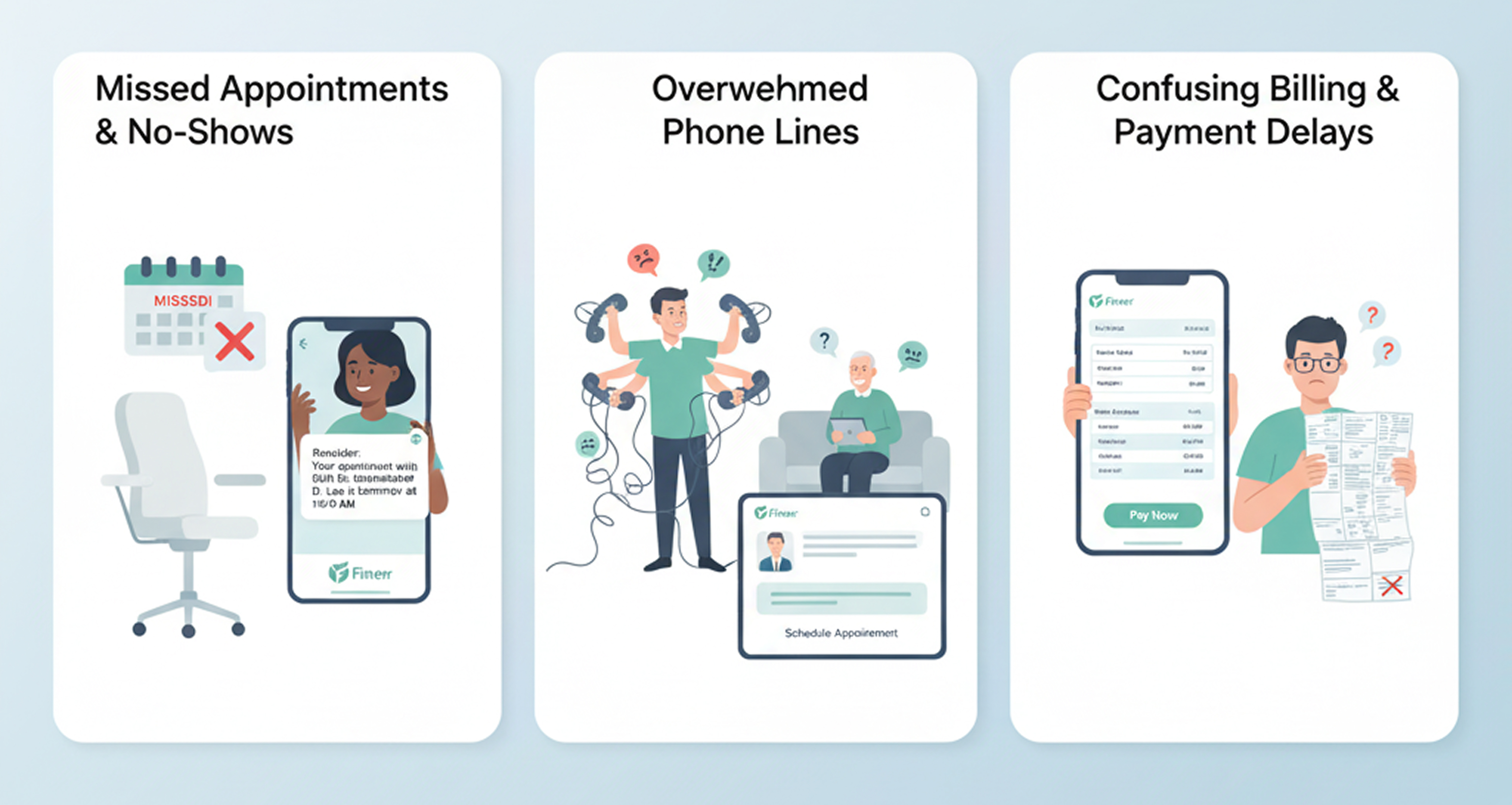
No-shows cost U.S. healthcare providers $150 billion annually . Patients forget appointments, misunderstand scheduling, or simply don't show up due to lack of reminders.
Result: Practices using Finerr see up to 30% fewer cancellations.
Receptionists spend hours answering repetitive calls about hours, refills, or appointments. Long hold times frustrate patients, and missed calls mean lost business.
Result: Staff spend less time on the phone and more time focusing on patient care.
Paper forms slow down check-ins, increase errors, and create storage and compliance risks. Patients often dread filling them out in the waiting room.
Result: Faster check-ins, fewer errors, and happier patients.
Many practices only communicate with patients at appointments. Without follow-ups, patients may forget instructions, skip refills, or leave for competitors.
Result: Patients feel cared for beyond the clinic walls, improving loyalty and adherence.
Billing remains one of the most frustrating parts of healthcare. Paper statements and unclear charges lead to confusion, delayed payments, and rising A/R balances.
Result: Practices using Finerr's payment tools collect faster and improve revenue.
Healthcare communication shouldn't be a barrier — it should be a bridge. Yet for many practices, missed appointments, overwhelmed staff, and outdated processes get in the way.
Finerr changes the game by providing automation, digital tools, and secure communication channels that reduce workload, keep patients engaged, and improve financial performance.
Pro tip: Start by solving your biggest communication pain point — like reminders or online scheduling — and then expand to reviews, payments, and forms for a full engagement solution.
Ready to improve communication and grow your practice? Request a Finerr demo today.
Read more about Finerr:


Absolutely. Finerr is designed for independent practices, offering affordable, scalable solutions that fit smaller teams.
Yes. All Finerr tools are HIPAA-compliant, ensuring security for texts, emails, and forms.
Finerr offers multi-channel communication (phone, text, email, app notifications), so patients choose what works best for them.
Most practices are up and running quickly, with results — like fewer no-shows and faster payments — within the first 60–90 days.
Healthcare communication challenges include missed calls, delayed responses, unclear messaging, and fragmented systems. These issues often lead to patient dissatisfaction and operational inefficiencies.
Clear communication ensures patients understand their care, appointments, and follow-ups. Poor communication can result in missed care, confusion, and reduced trust.
Missed calls often mean missed appointments, unanswered patient concerns, and lost revenue. Over time, they create frustration for both patients and staff.
Common causes include high call volumes, understaffed teams, disconnected tools, and reliance on manual processes. Without automation, communication gaps become unavoidable.
Technology automates routine communication tasks and centralizes patient interactions. This reduces delays, improves accuracy, and ensures patients receive timely responses.
A Patient Engagement Platform brings messaging, reminders, and follow-ups into one system. It helps healthcare providers maintain consistent and reliable communication with patients.
Automated messages ensure patients receive confirmations, reminders, and updates without manual effort. This reduces missed information and improves patient satisfaction.
Patients may feel unheard due to long wait times, unanswered calls, or unclear responses. Limited communication channels can worsen this experience.
Centralized systems allow staff to view all patient interactions in one place. This improves coordination and prevents important messages from being overlooked.
Yes, digital tools reduce reliance on manual processes. Automated workflows help prevent missed messages and incorrect information sharing.
Appointment reminders clearly inform patients about upcoming visits. This reduces confusion, no-shows, and last-minute cancellations.
Poor communication erodes trust and confidence in healthcare providers. Patients are less likely to return when they feel ignored or confused.
An IVR cloud phone system routes calls efficiently and provides self-service options. This ensures patients reach the right information without long wait times.
An IVR Phone system answers incoming calls automatically and guides patients to appropriate options. It reduces call congestion and improves accessibility.
A Scheduling Platform provides clear appointment details and confirmations. This removes uncertainty and keeps patients well informed.
Yes, automation handles routine interactions instantly. This allows staff to respond faster to complex or urgent patient needs.
Digital tools reduce repetitive calls and manual follow-ups. This frees staff to focus on patient care rather than administrative tasks.
Patients prefer different communication methods such as calls, texts, or emails. Offering multiple channels ensures better reach and engagement.
Key metrics include reduced missed calls, faster response times, lower no-show rates, and higher patient satisfaction scores.
Organizations can begin by centralizing communication, enabling automation, and adopting a Patient Engagement Platform with integrated phone and scheduling tools.