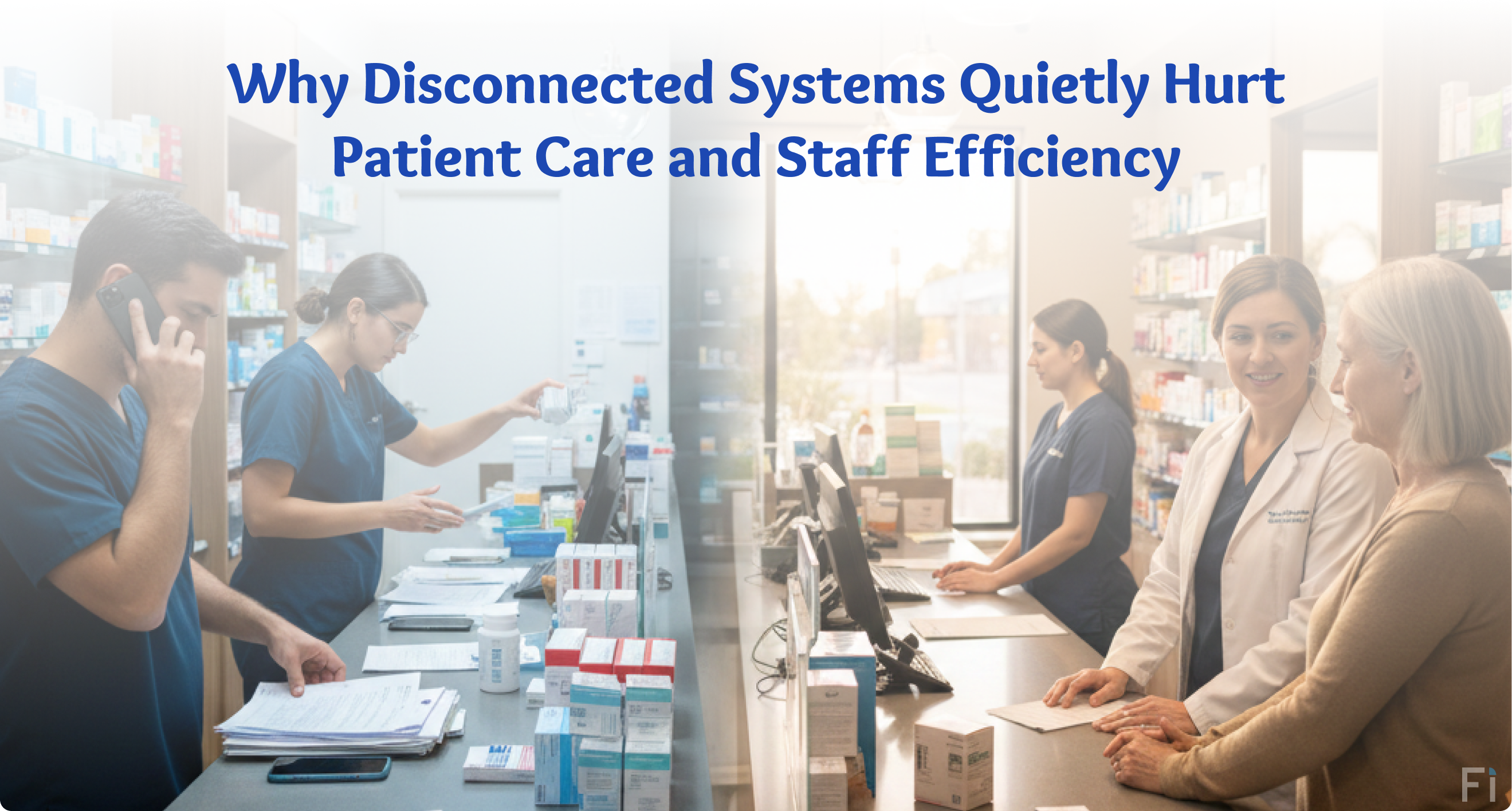
Why Disconnected Systems Quietly Hurt Patient Care and Staff Efficiency
Jayesh Sarawagi | Mar 4, 2026 | 3 min read
Explore this content with AI:


How Disconnected Pharmacy Systems Create Hidden Risks for Patient Care
Most pharmacies don't realize there's a problem until the consequences start showing up—missed messages, frustrated patients, overworked staff, and small errors that create big headaches. Often, these issues don't come from lack of effort or care. They come from disconnected pharmacy systems quietly working against the team.
When technology doesn't communicate properly, pharmacy teams are forced to act as the connection point. This slows workflows, increases stress, and ultimately affects patient care. In this blog, we explore how disconnected systems impact daily operations, why they hurt staff efficiency and patient coordination, and how integration makes a measurable difference.
What Are Disconnected Pharmacy Systems?
Disconnected pharmacy systems are tools and platforms that operate independently without sharing data or workflows. Each system may work well on its own, but together they create gaps.
Examples include:
- One system for calls, another for reminders
- Separate tools for workflows and reporting
- Manual handoffs between platforms
When systems don't integrate, staff must move information manually, increasing workload and risk.
How Disconnected Pharmacy Systems Impact Patient Care
Patient care relies on accuracy, timing, and consistency. Disconnected pharmacy systems make all three harder to maintain.
Common patient-facing issues include:
- Delayed responses to inquiries
- Conflicting or outdated information
- Missed follow-ups or reminders
- Reduced trust in pharmacy communication
When patients experience inconsistency, they call more often, ask repeated questions, and lose confidence—creating a cycle that further strains staff.
Read more: Disconnected Systems, Disconnected Care: Why Pharmacy Integration Matters
The Hidden Effect on Patient Care Coordination
Good patient care coordination requires systems to work together seamlessly. Disconnected pharmacy systems break that flow.
Without integration:
- Updates aren't shared in real time
- Staff lack full visibility into patient interactions
- Coordination between services becomes manual
This fragmentation makes it harder to deliver smooth, reliable patient experiences—especially for patients who rely on timely communication.
How Disconnected Systems Reduce Pharmacy Staff Efficiency
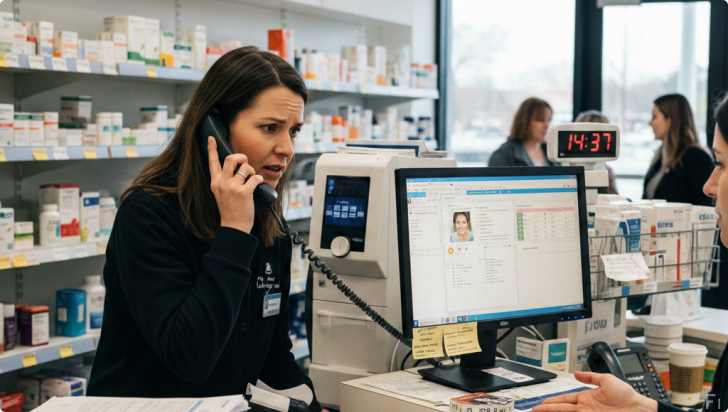
Pharmacy staff efficiency suffers when teams must constantly switch between tools. Each system change interrupts focus and slows task completion.
Disconnected systems force staff to:
- Enter the same data multiple times
- Search for information across platforms
- Resolve errors caused by mismatched records
- Spend time managing systems instead of patients
Over time, these inefficiencies compound, creating longer days and higher stress.
Why Workflow Automation Fails Without Integration
Pharmacy workflow automation only works when systems are connected. Automating one step while the next step lives elsewhere creates bottlenecks instead of efficiency.
Disconnected pharmacy systems lead to:
- Broken automation sequences
- Manual workarounds
- Inconsistent task completion
True automation depends on pharmacy system integration that supports workflows end to end.
Read more: Juggling Too Many Tools? Manage Everything from One Dashboard with FinerrThe Role of Patient Communication Automation in Integrated Systems
Patient communication automation works best when it's connected to pharmacy workflows. When communication tools operate separately, messages may not reflect real-time status.
Integrated systems ensure:
- Messages align with actual pharmacy actions
- Patients receive timely, accurate updates
- Fewer follow-up calls are needed
This reduces confusion for patients and lowers call volume for staff.
Why Pharmacy System Integration Is No Longer Optional
As pharmacy workloads grow and patient expectations rise, pharmacy system integration becomes essential. Integrated systems reduce friction and create clarity across operations.
Benefits of integration include:
- Improved pharmacy staff efficiency
- Better patient care coordination
- Fewer manual errors
- More predictable daily workflows
Disconnected pharmacy systems simply can't keep up with modern pharmacy demands.
How Finerr Helps Eliminate Disconnected Pharmacy Systems
Finerr is designed to replace fragmented tools with one connected platform. Instead of staff acting as the bridge between systems, Finerr centralizes communication, automation, and workflows.
Finerr helps pharmacies by:
- Eliminating disconnected pharmacy systems
- Supporting pharmacy workflow automation
- Improving patient communication automation
- Enhancing pharmacy staff efficiency
By bringing everything together, Finerr helps pharmacies operate with less stress and greater consistency.
Read more: How Finerr is Transforming Patient Engagement for Independent PracticesThe Long-Term Cost of Staying Disconnected
Disconnected systems don't just cause daily frustration—they create long-term risk.
Over time, pharmacies may experience:
- Higher staff burnout and turnover
- Lower patient satisfaction
- Increased operational errors
- Slower growth and scalability
Integration isn't just about efficiency today—it's about sustainability tomorrow.

Final Thoughts
Disconnected pharmacy systems don't fail loudly—they fail quietly. Over time, they erode staff efficiency, patient care coordination, and daily morale. By moving toward integrated systems, pharmacies can reduce errors, improve communication, and support their teams more effectively. Eliminating disconnected systems isn't just a technology upgrade—it's a foundational step toward better care and sustainable pharmacy operations.
Share this Blog :


Subscribe to Finerr Newsletter
Summary
Disconnected pharmacy systems quietly undermine both patient care and staff efficiency by forcing teams to manually bridge gaps between tools. This leads to delayed communication, repeated work, higher stress, and increased risk of errors. Without integration, workflow and communication automation fail to deliver real value. A connected system restores clarity, improves coordination, and supports safer, more sustainable pharmacy operations.
Get in Touch

Top 5 Challenges in Healthcare Communication and How Finerr Solves Them
Digital-First Pharmacies: How the U.S. Is Redefining the Drugstore Experience

Data That Drives Growth: Why Every Pharmacy Needs Smart Insights
Why Automation is the Future of Healthcare Growth in 2025

Top Features Physical Therapists Should Look for in Digital Tools
Unlocking the Future of Independent Pharmacies: Finerr at Xplore, a PrimeRx Event
FAQs About Disconnected Pharmacy Systems
What are disconnected pharmacy systems?
Disconnected pharmacy systems are tools that operate independently and don't share data or workflows. Staff must manually move information between platforms. This creates inefficiencies and increases the risk of errors.
How do disconnected systems affect patient care?
They cause delays, inconsistent information, and missed follow-ups. Patients may receive conflicting messages or slower responses. Over time, this reduces trust and satisfaction.
Do disconnected systems increase call volume?
Yes. When communication is unclear or delayed, patients call more often for clarification. This increases call volume and adds pressure on pharmacy staff. Poor system coordination directly fuels phone overload.
Can disconnected systems cause errors?
Yes. Manual handoffs and duplicate data entry increase the likelihood of mistakes. Without shared information, staff must rely on memory or workarounds. This raises both operational and patient safety risks.
How do disconnected systems impact staff efficiency?
They slow workflows by forcing constant system switching and multitasking. Staff spend more time managing tools than completing tasks. This reduces focus and productivity.
Is system integration expensive?
In many cases, integration costs less than ongoing inefficiencies caused by disconnected tools. Reduced errors, faster workflows, and lower burnout often offset the investment. Integration delivers long-term value.
Can small pharmacies benefit from integration?
Absolutely. Smaller teams gain significant efficiency from streamlined systems. Integration helps limited staff manage higher workloads without added stress.
Does integration replace staff roles?
No. Integration supports staff by reducing unnecessary manual work. It allows teams to focus on patient care rather than system management. Human expertise remains essential.
Why does workflow automation fail without integration?
Automation depends on systems sharing data and actions in real time. Without integration, automated steps break or require manual fixes. This limits the effectiveness of workflow automation.
How does integration improve patient communication?
Integrated systems ensure messages are accurate, timely, and aligned with pharmacy activity. Patients receive consistent updates without confusion. This reduces follow-up calls and frustration.
Are disconnected systems a compliance risk?
Yes. Inconsistent data and communication gaps can create documentation issues. This increases compliance risk and makes audits more challenging. Integration supports consistency and accuracy.
How quickly can integration improve operations?
Many pharmacies notice improvements within weeks of consolidating systems. Reduced interruptions and smoother workflows create immediate relief. Benefits continue to grow over time.
Do integrated systems reduce burnout?
Yes. Fewer interruptions and clearer workflows lower daily stress. Integrated systems help create calmer, more manageable workdays. This supports staff well-being and retention.
Can integration scale with pharmacy growth?
Yes. Integrated platforms are designed to grow with pharmacy operations. They support increased volume without adding complexity. Scalability ensures long-term sustainability.
Is patient care coordination affected by disconnected systems?
Yes. Care coordination suffers when systems don't share updates. Staff lack full visibility into patient interactions. Integration restores continuity and clarity.
Do integrated platforms reduce training time?
Yes. Staff learn one system instead of many. This shortens onboarding and improves confidence. Training becomes simpler and more consistent.
Can integration improve reporting accuracy?
Yes. Centralized data improves reporting accuracy and visibility. Pharmacies gain better insights into operations. This supports smarter decision-making.
Are multiple tools ever better than one system?
In most cases, multiple tools increase complexity without added value. Managing several platforms creates inefficiencies. A single integrated system offers better control.
How do disconnected systems affect teamwork?
They limit shared visibility and collaboration. Teams struggle to stay aligned when information is scattered. Integration improves coordination and teamwork.
Is integration becoming an industry standard?
Yes. Modern pharmacies increasingly rely on connected platforms. Integration is now essential for efficiency, patient care, and scalability.
Ready to Eliminate Disconnected Systems?
Finerr replaces fragmented tools with one connected platform for workflow automation, patient communication, and call handling. See how integration improves staff efficiency and patient care coordination.